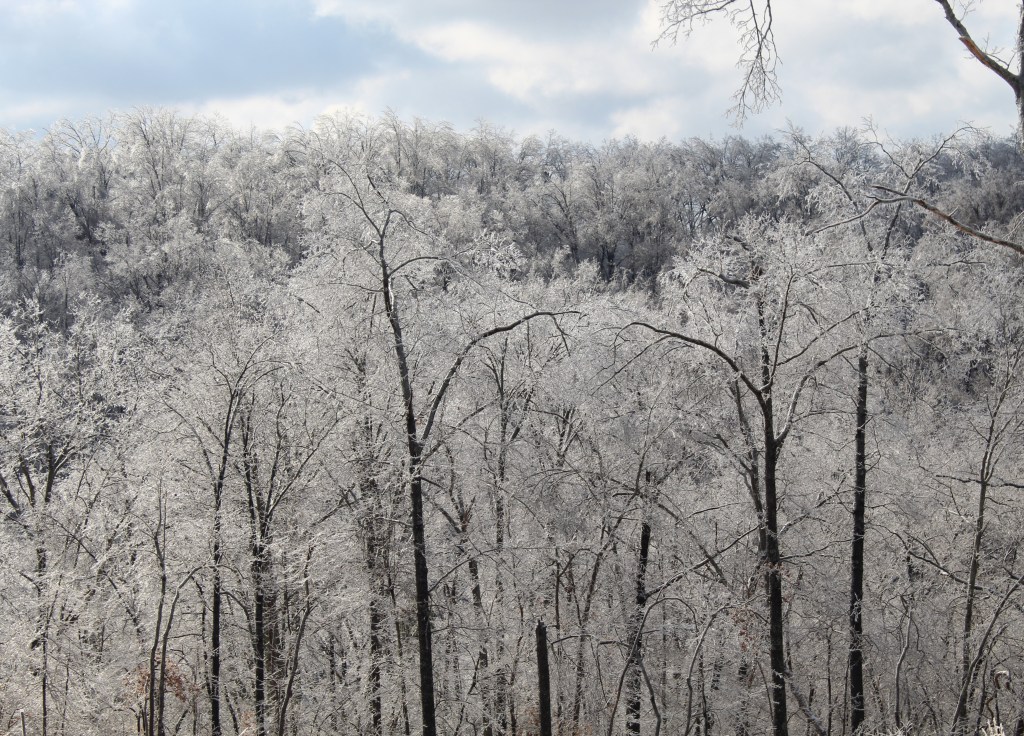
We are now post–ice storm, and four days post losing power.
The freezing rain brought with it a dependence on generators, which we expected in a storm of this magnitude. Days before the ice arrived, we filled the propane tank, stocked the pantry, made sure the cars had gas, put equipment on trickle chargers, and charged extra batteries. We did what we could to prepare so that the damages—whatever they might be—would be minimal.
But preparation does not always account for everything.
As the cold settled in, our carbon monoxide alarms began to beep, sending the dogs into a fearful tizzy. At first, we assumed a malfunction. We had already noticed that our electrician had not installed rechargeable batteries in the monitors, and it felt easier—safer—to believe it was just another inconvenience stacked onto the storm.
But every time I went upstairs in our barndominium to rest, the deepest, most peaceful sleep would take hold of me and pull me under.
It reminded me of Dorothy in the poppy fields on her way to Oz.
The last time I let my eyes close and surrendered to that bliss, I heard my husband’s voice from somewhere far away, yelling for me to wake up. There was a piercing alarm, but I buried my head deeper into my pillows and pulled the blankets over me, trying to escape the cold.
Instead, my husband dragged me from the bed.
He told me I had to get up. That there was carbon monoxide in the house. That the high winds had kicked fumes from the generator back into our home.
Like a drugged slug, I pulled on my Elmo onesie—ridiculous and incredibly warm—and with his help staggered down the stairs. I collapsed onto an ottoman and fell into a deep sleep so heavy that even the open windows and icy air couldn’t wake me.
At some point, I felt my fat basset hound jump up beside me, burrow under the blankets, and press himself against me for warmth. I woke briefly, hugging mounds of fur and weight, before slipping under again.
Morning came in fragments. From a distance, throughout the night, I heard my husband moving, checking on me, checking on the animals. When the icy air finally hit me like a bucket of cold water, the fog in my mind lifted.
It wasn’t until I stepped outside that I understood what had been happening.
My shallow breathing wasn’t anxiety or exhaustion. It was carbon monoxide poisoning.
We’ve since moved out of the barndominium and into a smaller building while we figure out how to relocate the generator. Only after leaving did I realize how labored my breathing had been—how intoxicating and dangerous the inability to breathe fresh air truly is.
Now we are on day four with no electricity.
As much as I want to avoid politics—to stick my head in the sand like an ostrich and just live my life doing what I love, being of service to the land and my local community—I have to say something.
Our local government has completely forgone us during this ice storm.
They stopped plowing “their regular route” two county roads down and more than four miles from the farm. So I got on my soapbox and chewed a few ears—from the Roads Department all the way up to the two main contenders for state representation.
It’s disgusting, really, when you pay equal taxes and don’t receive equal representation or benefit.
We may live in the woods, but we—and our neighbors, sitting in the dark and cold—deserve access to emergency medical services. We deserve safe passage in and out of our county roads. It should not be political for local government to ensure roads are passable during a historic storm.
Many of our neighbors are homesteaders. Some homeschool. Many are elderly. All are taxpayers. And all should be guaranteed access and safety during an emergency.
Most of us are on well water. Without electricity, there is no water. And even propane trucks can’t reach us when county roads are left untouched.
This may be a rant for another time.
Because feeding people nutrient-dense food and caring for your community should not be political.
But in the intensity of a historic ice storm—when the cold presses in, the power stays off, and the air itself becomes dangerous—the feelings are magnified.
And sometimes, survival demands that we speak.


Leave a comment