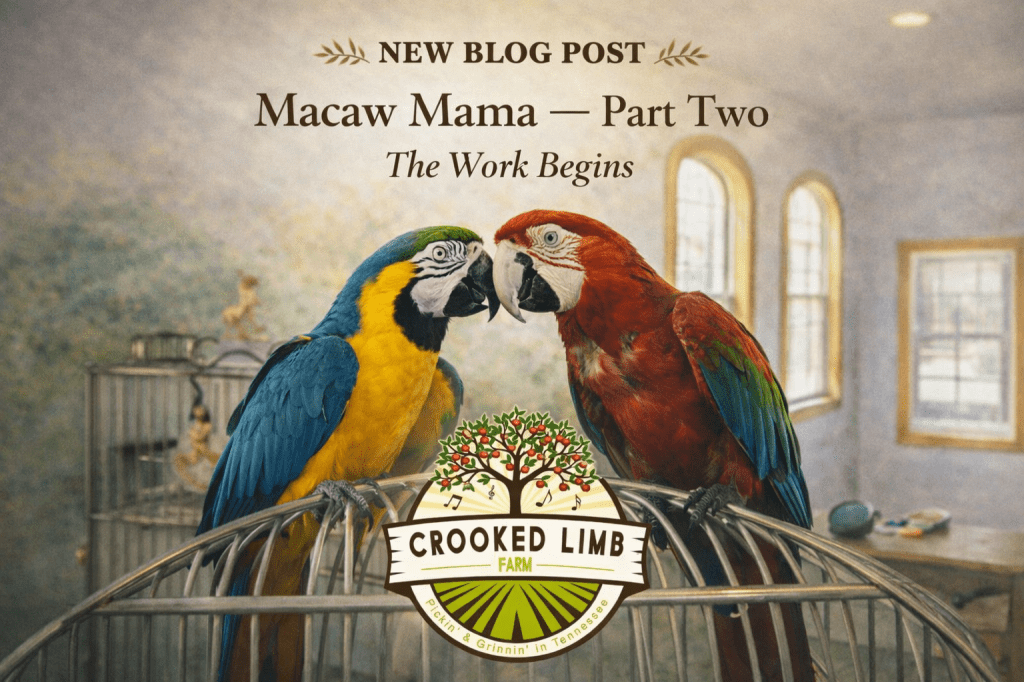
Bogart and Jazz are doing well here.
But it isn’t all sunshine and roses.
The two-hour drive home, the unloading, the reassembling of their cage — it was all layered with exhaustion and adrenaline. They were as pliable and sweet as they had been when we first met them, almost as if we were all suspended in the same fragile bubble of transition.
But bubbles settle.
Because the opportunity to adopt them came before we were fully prepared, our first few days were filled with rapid adjustments — ordering larger cages, natural perches, a double java tree stand, toys strong enough to withstand beaks built to splinter wood. In the wild, macaws fly miles each day. They forage. They solve problems. They choose where to perch and when to retreat.
And here we were asking two twenty-seven-year-old rescue macaws to absorb a new home, new rhythms, new caretakers — all at once.
That kind of change doesn’t land quietly, especially when you’re transitioning adopted parrots into a new home environment.
Which brings me to training — specifically, how we begin positive reinforcement training with adopted macaws.
I believe deeply in training animals. Training is the bridge between species — not about control, but about clarity. It’s where expectations become visible, and where both sides slowly learn the rhythm of the other.
It is the space where the animal clearly understands what I’m asking, and where I begin to understand what they are ready — or not ready — to offer.
My husband approaches animals with softness and openness. He leans toward freedom first. I lean toward structure. Somewhere between us, stewardship forms its shape.
In our home, I am the limiter of treats. The establisher of schedules. The one who sets boundaries.
Our ducks and geese understand this dynamic well. The shake of a tambourine means it’s time to single file into the duck house. A gentle “shoo” sets a boundary. The word “acorns” sends them reporting for pest control duty. We have an agreement.
If my husband tries to shoo them, they assume he’s playing. He laughs. I do not.
And now, I find myself mapping out that same kind of understanding with two macaws.
We’ve had real wins.
And we’ve had setbacks.
If I’m honest, some of those setbacks were mine.
Temporarily housing them together while we waited for larger cages likely added tension — something common when integrating bonded macaws into a new household. Introducing my phone too quickly certainly didn’t help — Bogart fluffs at the sight of it. And I moved too quickly with my hands, assuming that previous training would translate seamlessly into daily life with us.
It didn’t.
I’ve been bitten three times — each one a lesson in understanding macaw body language and boundary-setting.
The first was inside his cage while I was changing bowls. He wrapped his beak around my index finger and squeezed. Not full force — but firm enough to alter how I move.
The second was a calculated grab of my hair while he perched above me, a reminder that proximity does not equal permission.
The third was entirely my fault.
On day five, I introduced the clicker to begin pairing the sound with a reward — the foundation of clicker training for parrots. A click means a treat. Simple. Clear.
Except I clicked too close.
The sharp sound startled him. He dropped the treat and grabbed my fingers. The damage was negligible, but the message was not.
So I stepped back.
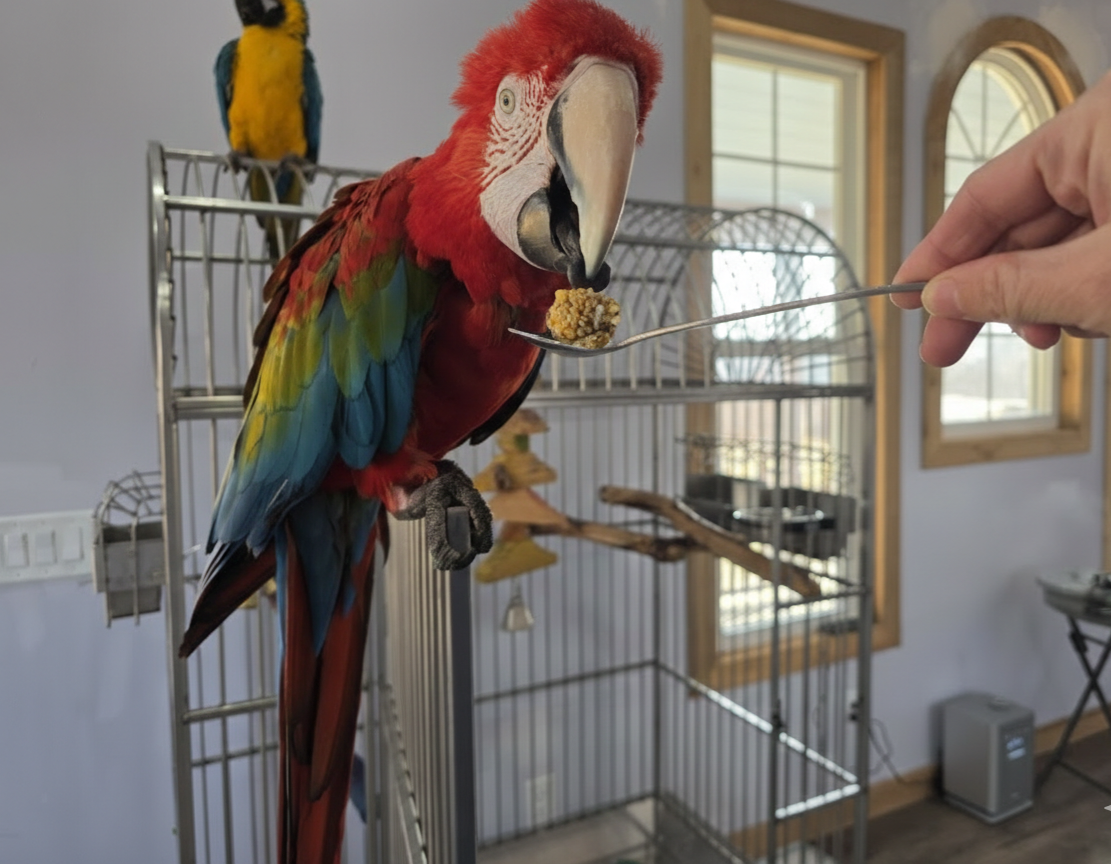
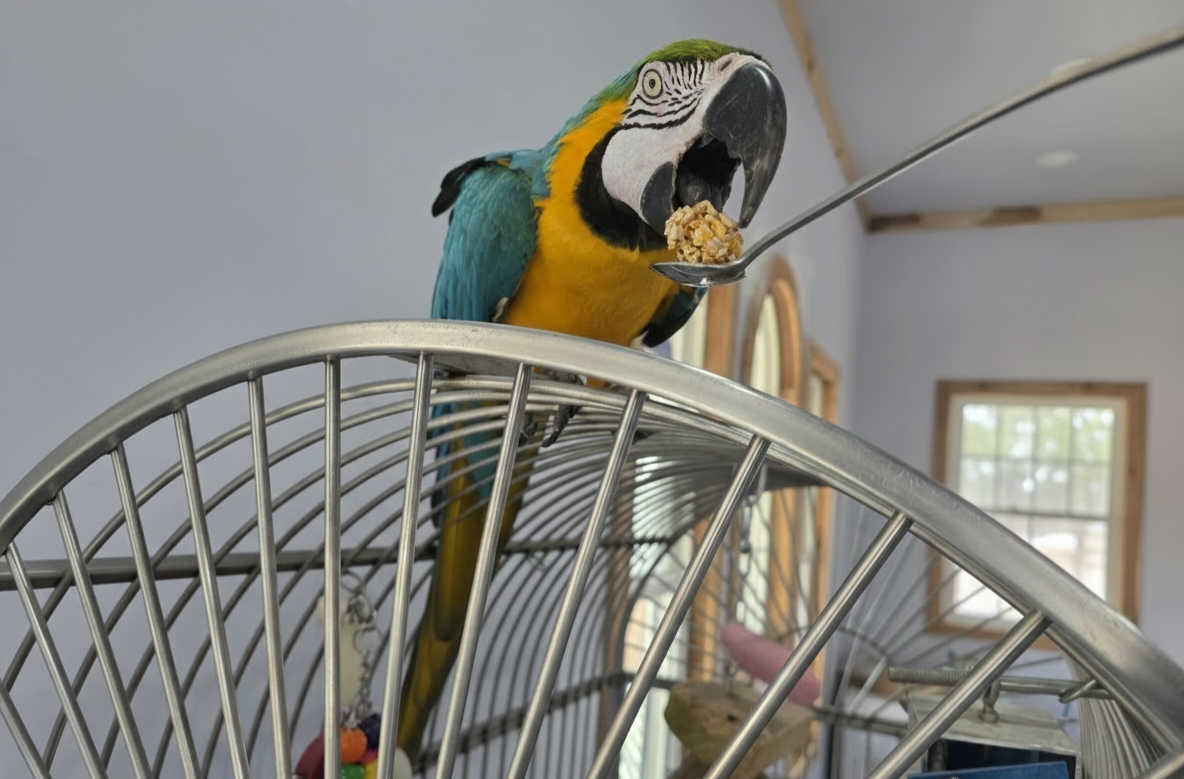
We are still clicker training, but for now I offer treats with a long spoon instead of my hand. A click means a treat — delivered calmly and predictably. When their larger cages arrive, they will be separated but side by side. They will still share communal time and enrichment, but individual space will allow individual relationships to grow — an important step when building trust with rescue parrots.
We will crawl before we walk. Walk before we jog.
Target training will come later. Advanced behaviors later still.
Right now, the work is quieter.
With adopted parrots — especially ones who have already lived long, full lives elsewhere — I try to hold a realistic timeline in my mind. The first stretch is simply about trust. Sometimes that begins to settle in a few weeks. Sometimes it takes six. Comfort, the kind that lets everyone exhale and move without bracing, often starts to appear somewhere around the two- to three-month mark. And true bonding — the steady, mutual understanding that isn’t built on novelty or food but on consistency — can take six months. A year. Occasionally more.
There is no shortcut through that unfolding. Only calm repetition. Clear signals. And the quiet accumulation of days in which nothing frightening happens and something small goes right.
So we are not behind.
We are simply at the beginning.
It is about trust. About mutual respect. About recognizing the difference between affection and access.
They are intelligent. They are communicative. And they are watching us just as closely as we are studying them.
In Part One, love opened the door.
Now, we begin the steady work of building something strong enough to last.
If you’d like to follow along as Bogart and Jazz settle into this next chapter of life as adopted macaws, you can find them on Instagram at @rootedwithfeathers, where the daily wins, lessons, and occasional side-eye are all part of the unfolding story.
Because love may bring them home —
but patience is what will keep us growing together.


Leave a comment