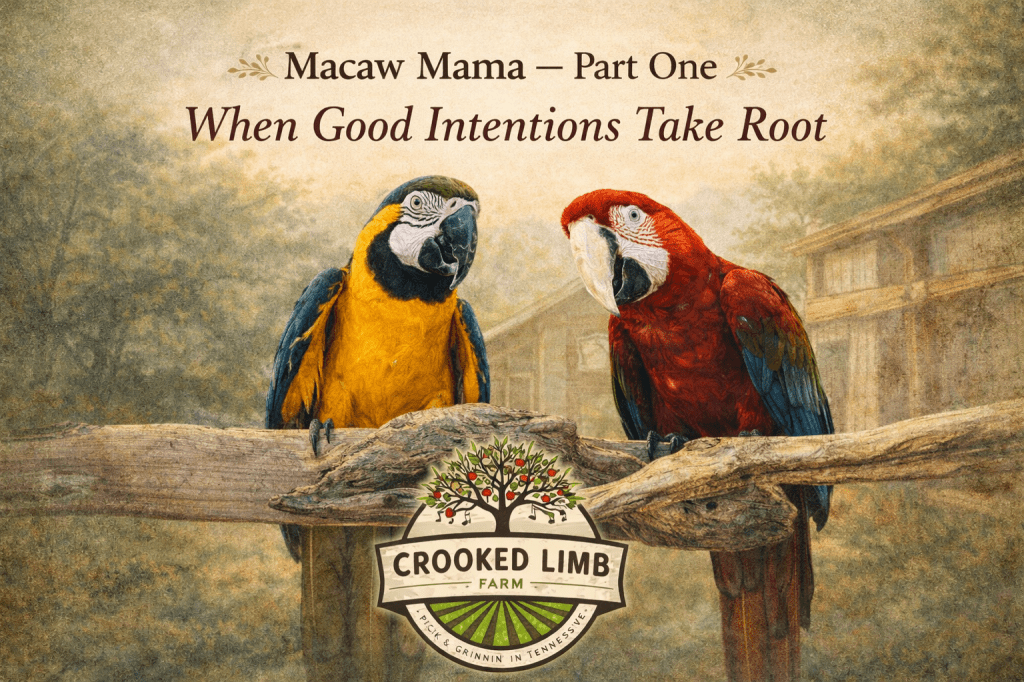
Yesterday, I became a macaw mama.
My husband and I love our ducks and geese, and while there are plenty of charming animals that find their way onto farms, we both agreed our next addition would be something different. A parrot. So, on our anniversary, we took the first step toward parrothood and placed a deposit on a baby Hyacinth Macaw.
My husband has always loved Hyacinth macaws, and because we’re not fans of animals being alone, we planned for a companion as well. When it came to choosing that future partner, I waffled. Not because I didn’t want one—but because all macaws are beautiful, and I couldn’t decide whether a blue-and-gold or a green-wing would be the right fit. Each breeder we spoke with had a different opinion. Google had opinions. AI had opinions. None of them quieted the deeper question that kept resurfacing.
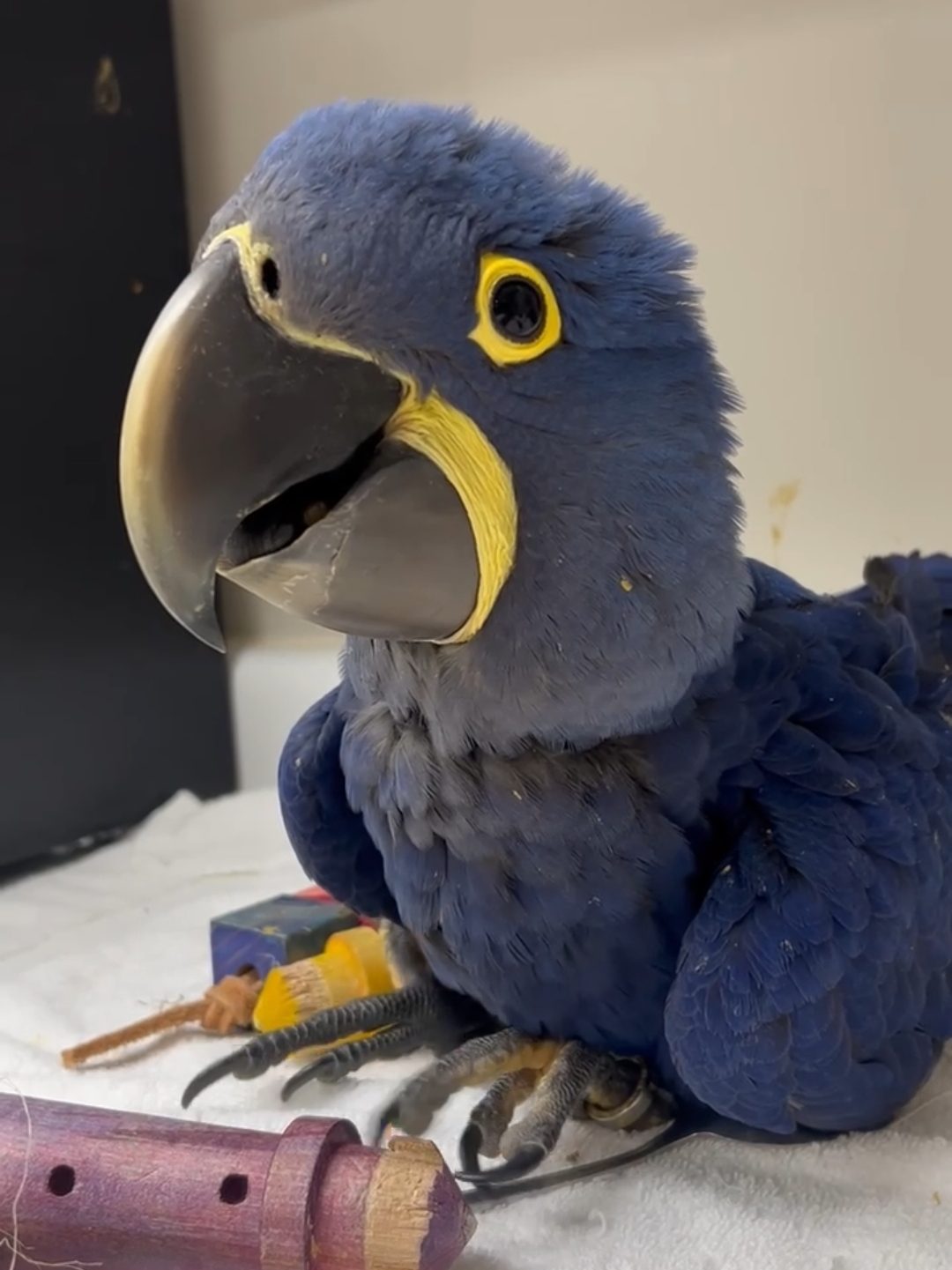
Parrots are not casual commitments, especially when it comes to adopting macaws or other long-lived companion birds. They require time, attention, and specialized care. Their long lives mean that even when people begin with the best intentions, circumstances can change, and birds often outlive the stability that once surrounded them. I found myself thinking not just about bringing a parrot home, but about what happens to parrots when life unravels—and why rehoming parrots has become such a quiet necessity.
That’s when I began following the Exotic Avian Sanctuary of Tennessee on social media.
Not long after, the founder shared a rescue story that stopped me in my tracks.
A call had come in about a man who had been hospitalized and placed on a mental health hold. A family member, checking on his property, discovered birds living in his barn and feared they wouldn’t survive much longer. When photos were sent, it was immediately clear the situation was urgent.
The birds were housed in a small tack room inside a barn so cluttered with debris it was difficult to even reach the door. The air was heavy with mold and decay. Several cages were rusted shut—some so neglected they hadn’t been opened in years. Food and water had been poured in wherever there was space, layering old mold, waste, and time on top of one another.
What struck her most wasn’t just the physical neglect, but the silence. No singing. No chatter. Just birds who had lived long enough in isolation that they seemed to have accepted it.
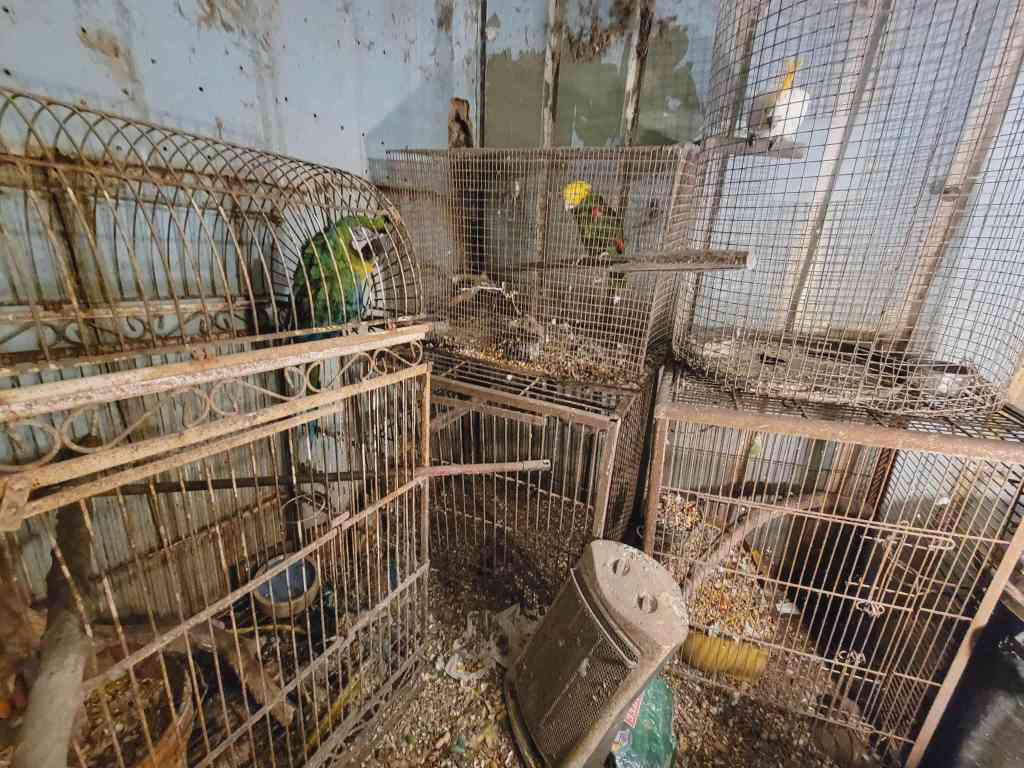
In total, twenty-three birds were removed that day—budgies, doves, a pigeon, a cockatoo, an Amazon, and a hybrid macaw. They were relinquished into the care of the sanctuary, where they could finally rest, stabilize, and begin the slow work of healing.
That story stayed with me—not just as a tragedy, but as a quiet question I couldn’t unhear.
There were photos shared alongside the post, including one of a stunning miligold macaw. Something inside me pressed hard, urging me to reach out and ask about meeting him. But healing takes time, and the miligold needed emotional stability before anything else. So I tucked my hopes away, though adoption continued to whisper in the background of my heart.
Then, in the middle of this historic ice storm, I received an email from the founder of the sanctuary.
She asked if I would be interested in rehoming two macaws from a retiring farmer.
I didn’t hesitate to ask my husband what he thought. To my surprise, he was open—open to talking, to meeting, to seeing what this might look like.
On day nine, late Tuesday evening, our electricity was finally restored. By Friday, we had plans to meet Jazzy and Bobo.
Friday morning, I woke with a low hum of anxiety. I wasn’t sure what to expect, and I worked hard to keep my expectations tempered. The one-hour-and-forty-minute drive stretched past two hours, the road somehow lengthening instead of closing the distance.
But when the barn door opened and I looked to my left, I saw them perched quietly on the rail.
And just like that, my heart swelled—full and immediate. It was instant love.
The fear of long-term commitment, the uncertainty of adopting older parrots—not one but two twenty-seven-year-old macaws who had lived more than half of my life already—it all fell away.
Before we left, standing there with the weight of the decision still settling in, I learned more of their story.
Jazzy and Bobo would be coming to us as they entered their third home.
Their first home had been with a woman who loved them deeply and cared for them for many years. When a new puppy joined her household, she made the difficult decision to limit their previously open access to explore outside their cage in order to keep them safe and secure. This necessary shift—from a home where they had enjoyed more freedom to one where they needed to remain safely caged—was made out of protection and responsibility. Over time, and due to her own health challenges, she recognized that they deserved a home where that freedom could be restored and their daily lives could expand again.
When they were eventually rehomed to the retiring farmer, their environment changed significantly. There, they experienced a more open daily rhythm—spending increased time outside their cages, engaging with visitors, enjoying outdoor misting, and becoming part of the gentle cadence of farm life.
That mattered to me. Not because it made this easier, but because it reminded me that animals, like people, carry the imprint of every life they’ve lived before they reach you.
In becoming their third home, I’m holding space for all of that history—and quietly hoping we might also be their last.
With that hope comes intention. As they begin this next chapter, Jazzy will become Jazz, and Bobo will return to Bogart. Not to erase who they’ve been, but to mark where they are now. A gentle shift. A way of saying: you’re here, and this life will be held with intention.
Animals seem to know when things are different. On instinct, Bobo—soon to return to Bogart—sidestepped closer to the wall and offered my husband a non-aggressive warning air bite as he excitedly reached out. My husband loves animals even more than I do, and the presence of a bird with jaws strong enough to require steel toys did nothing to deter him. He encouraged him to step up, beginning the slow work of trust.
I’m slower. I move at a snail’s pace when it comes to earning an animal’s affection. I prefer to let them find their way to me, to set the rhythm of our relationship. Together, I think my husband and I make a good pair of stewards.
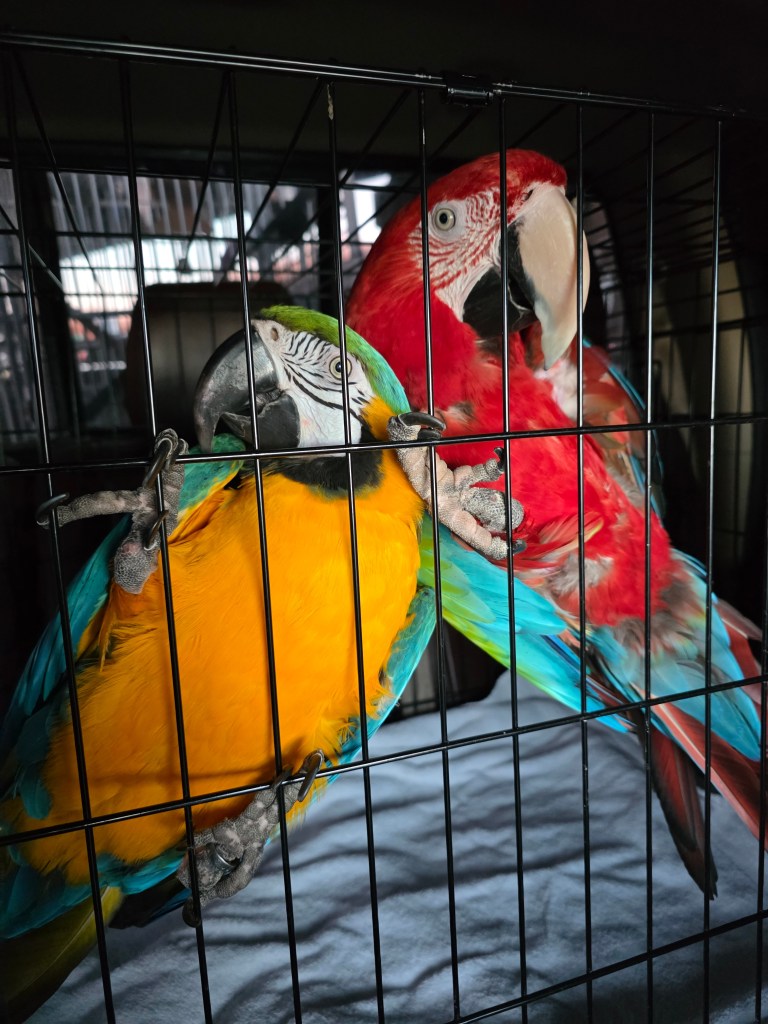
Jazz, the blue-and-gold, and my husband became smitten almost immediately. She responded to him in her own macaw language, and somehow they seemed to understand one another—even if, to outsiders, their words sounded nothing alike.
When it was time for Bogart and me, I felt the warmth of his small palm against my hand—something entirely new. He gave me a once-over, then stepped back onto the rail, maintaining eye contact as he moon-walked backward until I had to stop him from tumbling off the edge.
It’s hard to separate animals from the people who love them, and I know that day was heavy for the farmer. We felt something similar when we had to rehome our turkeys after the waterfowl began bullying them. Even though they went to a friend’s regenerative farm just down the road, my husband still carries a quiet ache from that decision.
I tried to offer the kind of reassurance I wish I’d had then—to let her know this wasn’t a goodbye, but an until.
The ride home felt just as long as the drive there, but for entirely different reasons.
This time, the backseat wasn’t empty.
We brought them home carrying decades of history we didn’t yet know how to hold.
Love may have opened the door—but the real work was only beginning.
As they begin this next chapter, we’ll be sharing glimpses of Bogart’s and Jazz’s life here on Instagram at @rootedwithfeathers.


Leave a comment