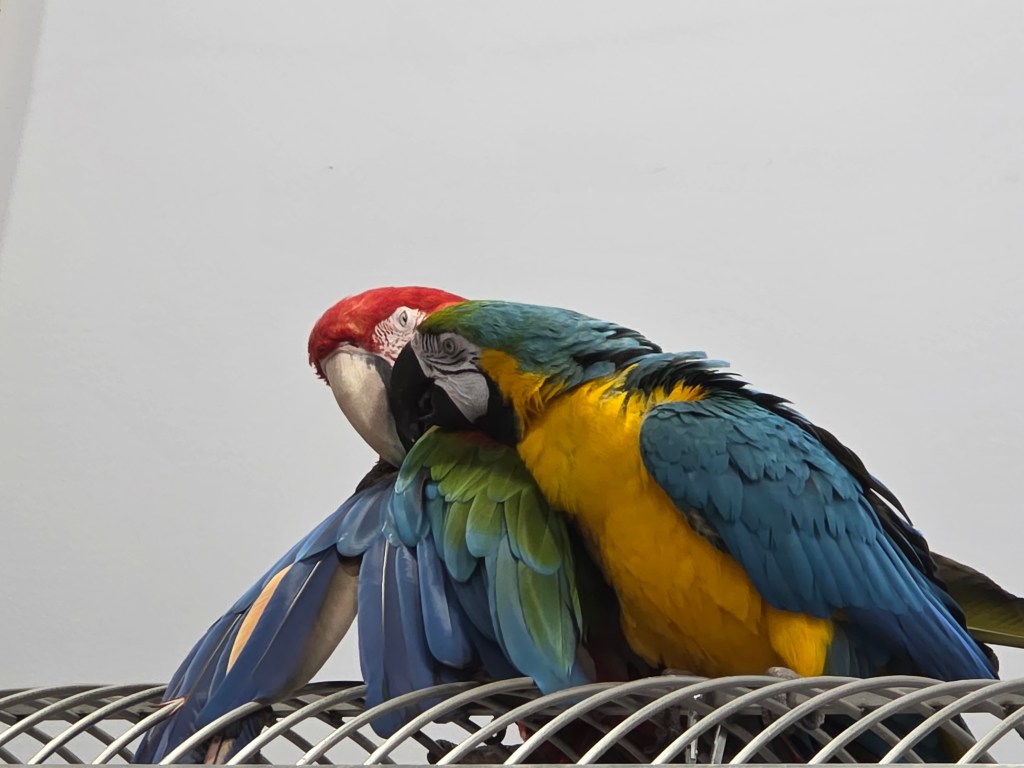
Week two of adopting our bonded macaws has been hard.
The only way I can describe it is like living inside a Tom Hanks movie — equal parts The Green Mile and Forrest Gump. I have felt every emotion under the rainbow, and a few colors I didn’t know existed.
There have been beautiful days.
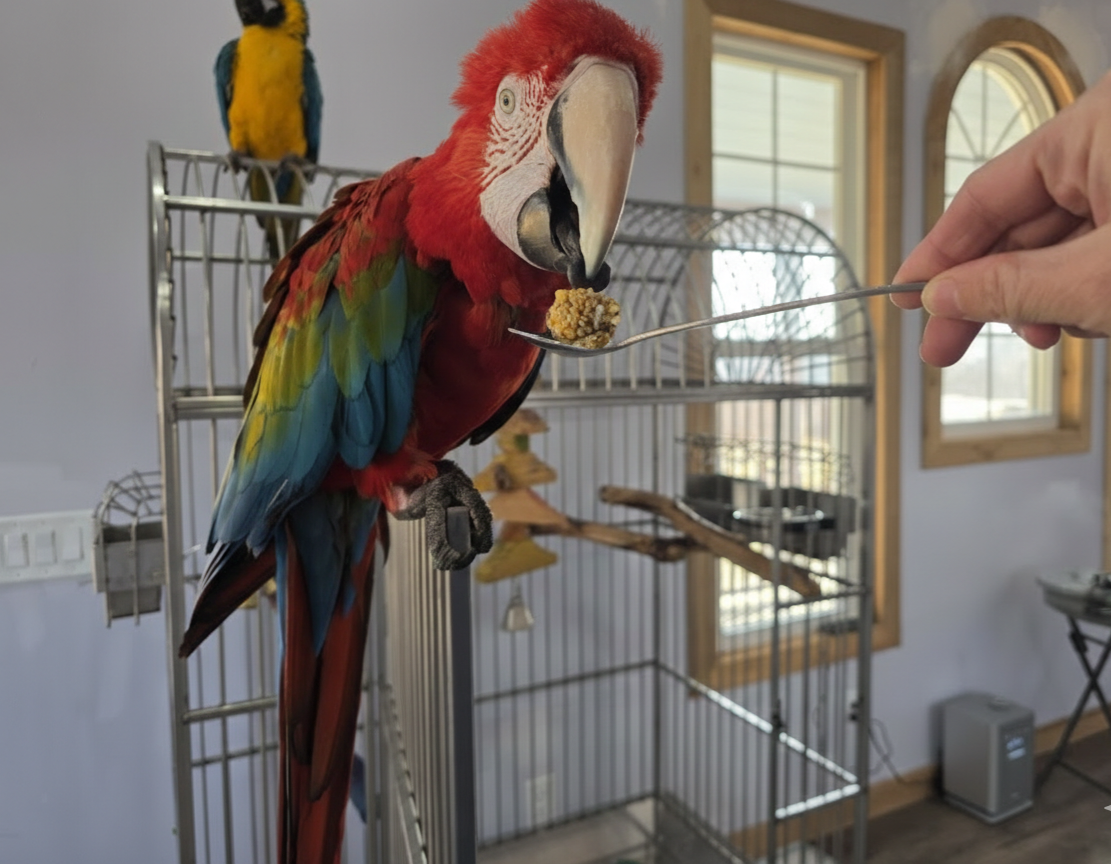
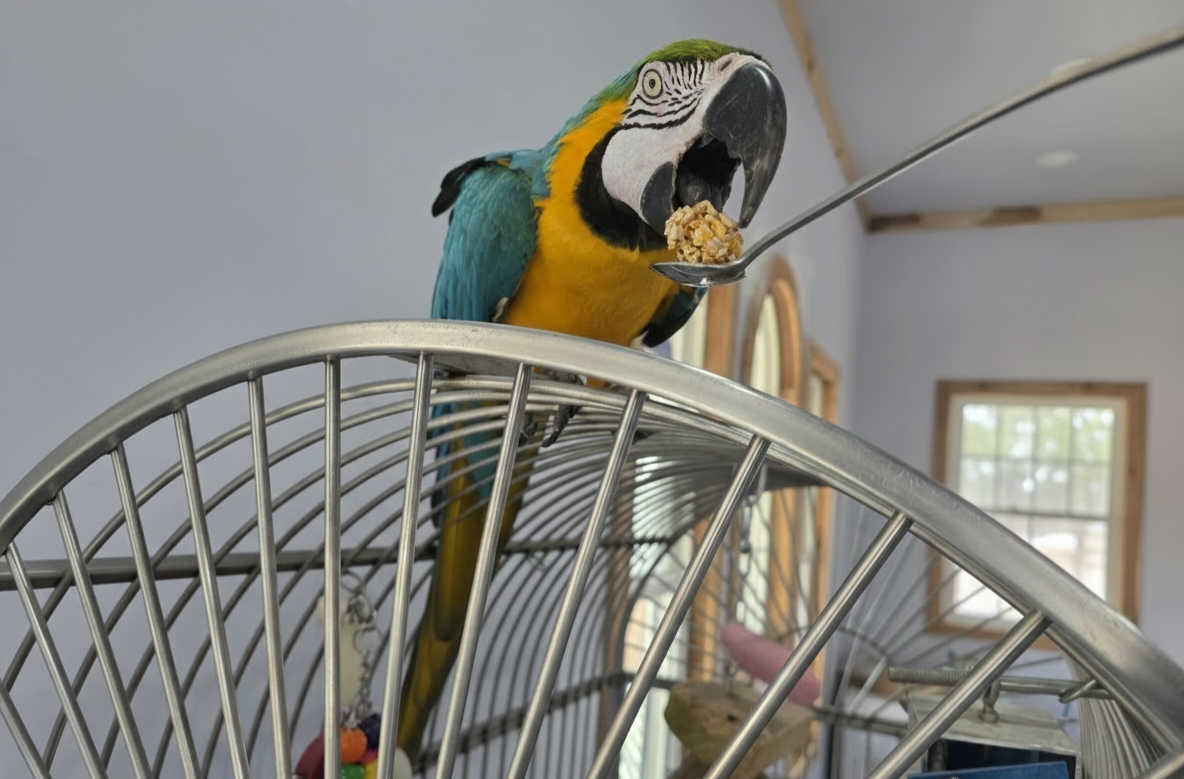
Days where Bo tracks the target stick around the cage, waits for the click, accepts his walnut piece, and repeats “achoo” after me three times in a row like we’re sharing an inside joke.
And then there have been the other days.
Mornings where I am greeted not with curiosity, but with a lunge.
When Adopted Parrots Begin Testing You
Around the two-week mark, something shifts in adopted parrots.
In the first few days of bringing home a rehomed parrot, they are often quiet, observant, almost polite. They are assessing. Surviving. Figuring out where they are.
Then, around week two, many parrots enter what behaviorists call the testing and defense phase of adaptation.
They realize: “This is not temporary.”
And that’s when the real emotions surface.
This is exactly where we are.
The Bonded Pair Dynamic
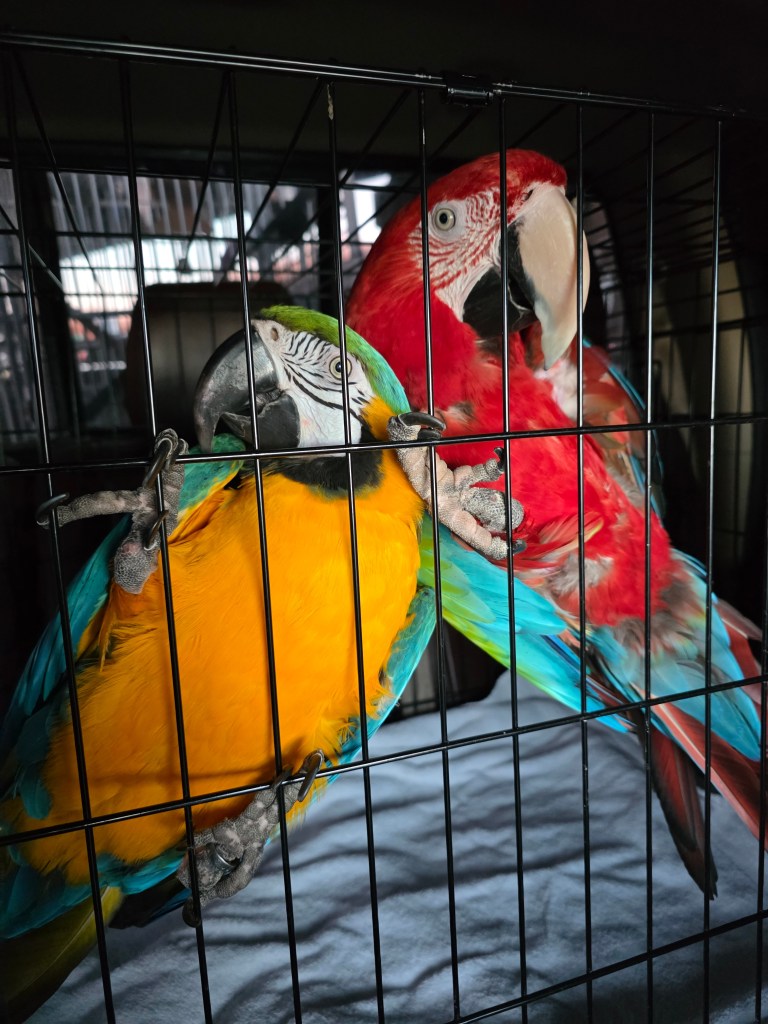
Bo and Jazz are a strongly bonded pair — a male green-winged macaw and a female blue-and-gold macaw who have lived together for years.
Bonded parrots share more than space. They share security, instinct, and territory.
Because they are temporarily housed in the same cage while we finish preparing their permanent space, that cage has effectively become a nest.
And nests are guarded.
Bo has decided that his job is to control access. He directs me with his beak — when I may approach, when I may change water bowls, even when I may pass. It’s not personal. It’s instinct.
Jazz, my quiet and stoic girl, emerged from her shell this week too — but not in the way I expected.
She began exploring the cabin for nesting material. Towels became treasure. She pulled one from a sawhorse, cooing softly while arranging it with her beak and claws. Bo joined her, of course.
It was adorable — until it wasn’t.
When it came time to remove the towel and guide her back to the cage, she charged. Wings spread. Beak forward. And even though she is technically “the smaller bird,” I was frozen on top of a chair while she guarded the floor below.
This is the moment where I understood something critical:
There is no disciplining a wild animal acting on instinct.
There is only management, understanding, and behavior adjustment — mostly mine.
How Shared Caging Affects Adjustment
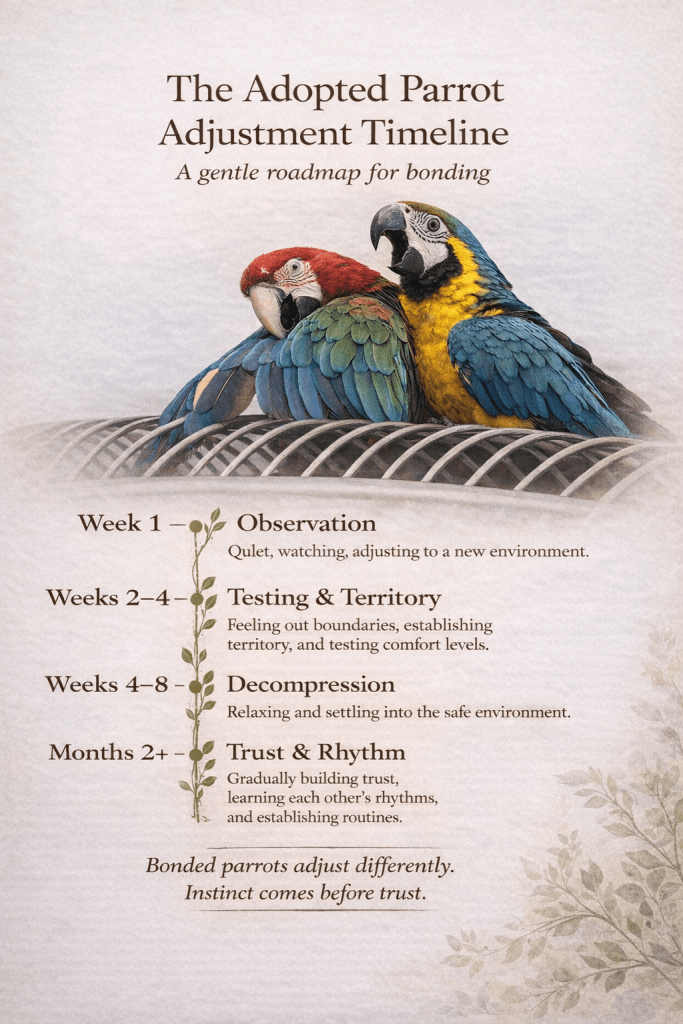
Research on adopted parrots moving into a new home shows that the adjustment timeline often follows predictable stages:
Week 1 — Shock & Observation
Eating. Watching. Assessing.
Weeks 2–4 — Testing & Territorial Defense
Lunging. Guarding. Hormonal behaviors. Bond reinforcement.
Weeks 4–8 — Decompression & Stability
Reduced guarding. Curiosity returns. Trust begins forming.
We are squarely in stage two.
Because Bo and Jazz are a bonded pair sharing a temporary cage, their territorial instincts are amplified. Shared housing in a new environment can unintentionally create a “them versus me” dynamic.
Instead of integrating into a new flock, they consolidate into each other.
The environment I created — unintentionally — reinforced nest behavior.
Jazz hunted for materials.
Bo guarded the perimeter.
I reacted defensively.
Trust dipped.
And the more I tried to regain control, the more control they attempted to assert.
It became a cycle.
The Emotional Toll of Parrot Adoption
The emotional whiplash has been real.
Great days followed by lunging.
Peaceful evenings followed by territorial mornings.
Jekyll and Hyde personalities that left me questioning everything.
I have felt:
- Hopeless
- Overwhelmed
- Physically unwell from stress
- Afraid I made a mistake
- Afraid they would never love me
No one talks enough about the emotional impact of adopting large parrots.
Macaws are intelligent, sensitive, hormonally complex, and deeply bonded creatures. When you adopt a bonded pair, you are not stepping into a blank slate — you are stepping into an established relationship.
That takes patience.
What Is Going Right
Despite the chaos, there are strong signs of healthy adjustment.
They eat beautifully — fresh fruits, vegetables, pellets, and nuts used strategically for training.
Reducing high-fat nuts has already helped regulate hormonal behavior.
We increased their quiet, dark sleep time to minimize hormonal triggers.
They scream when I leave the room — which, in parrot language, is not rejection. It’s a contact call. Flock cohesion.
They are not fearful.
They are adapting.
Meanwhile, my husband and I are preparing their permanent space in the barn — painting with non-toxic paint, building their separate cages, hauling the massive java tree upstairs.
Stability is coming.
The Reality of the Two-Week Mark
Two weeks feels like forever when you are living it.
But in macaw time, two weeks is barely an introduction.
If the adaptive timeline holds true,
In the coming weeks we should see:
- Reduced territorial lunging
- Less nest-seeking behavior
- Increased curiosity
- More individual interaction
Not because we forced it.
But because consistency creates security.
Adopting bonded macaws is not about instant affection.
It’s about becoming steady enough that they choose you.
And right now, we are in the messy middle.
But we are, according to every piece of research I’ve read, right on schedule.
You can follow along as Bogart and Jazz continue settling into their new life and finding their rhythm here at Crooked Limb Farm. We’re sharing the real, unfiltered journey of bonding, setbacks, and small victories over on Instagram @RootedwithFeathers