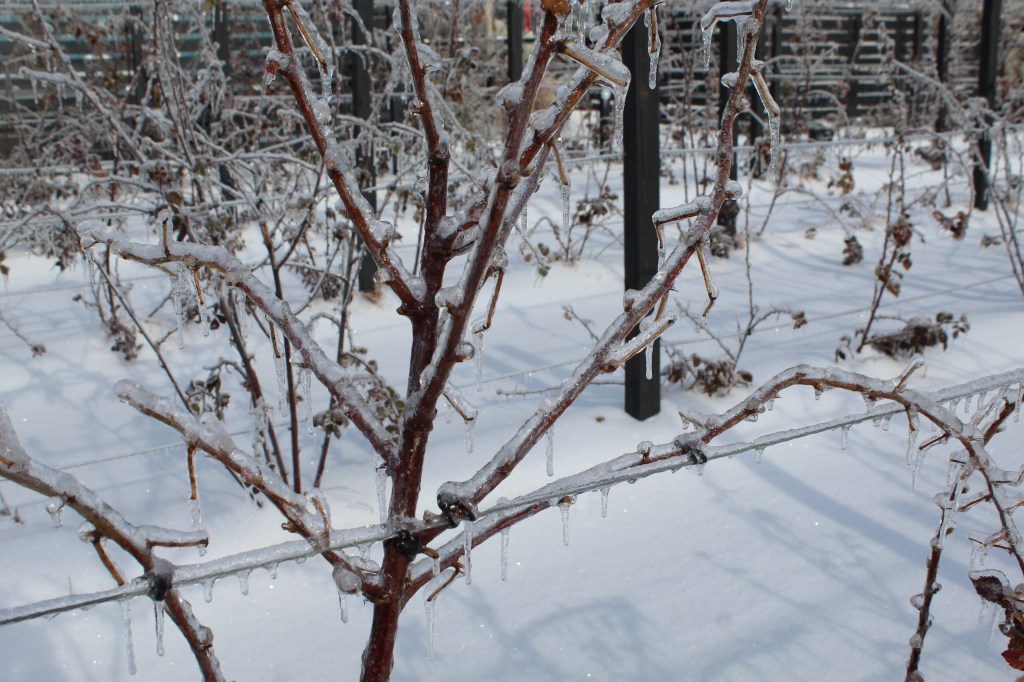
I want to say that I am facing this devastation with stoicism. But I think what I’m really experiencing is shock—shock that hasn’t yet found a way to express itself as a single, tangible emotion.
Imagine the color spectrum with its seven colors: red, orange, yellow, green, blue, indigo, violet. When you look at a sunset, you see all of them, plus everything in between. That’s the only way I can describe my emotional state right now. There are recognizable emotions—happy, sad, mad, hopeful, despair—but instead of landing in one, I feel like a blend of all of them at once.
Snowmageddon hit us with an unexpected fury, almost as suddenly as the tornado of 2021.
The days leading up to this ice storm were warm. And with Middle Tennessee weather being fickle at best—and local meteorologists hovering around fifty percent accuracy on any given day—I’m not sure what I expected. But it definitely wasn’t this.
We prepared as we would for any normal winter storm.
We ran the cars and machines to preserve the batteries. We stocked up and spread salt. We made plans for our ducks and geese. We completed routine winter chores throughout the vineyards and orchards—warming roots with extra soil and straw, checking that vines were lifted and secured to their wires, painting the bases of the fruit trees white to protect against freeze-thaw cycles and damage from field mice and other critters chewing on tender bark.
I worried about my lavender. I had planted varieties that don’t tolerate temperatures below fifteen degrees Fahrenheit. But emotionally, I was prepared to lose them—to replant in the spring or redesign the space with more cold-hardy varieties. My expectations there were low. I didn’t carry any additional worry or stress about it into the storm.
Maybe the first clue should have been the way people kept referring to it as Snowmageddon.
When clients mentioned it while we were discussing schedules, it sounded funny—overly dramatic, even a little ridiculous. Northeastern states regularly endure temperatures in the negative thirties. Snow is simply part of life there. After an unseasonably warm winter, a little cold weather in January felt overblown.
But I was wrong.
And I think that is where the shock comes from.
Around five in the morning, I heard the generator kick on. That isn’t unusual here, where poor infrastructure means strong winds, heavy rain, or the occasional drunk driver can take down an electric pole. My husband was already awake, caring for the dogs and livestock.
When I looked out the window, I saw what I expected—gray, dismal skies and a blanket of powdery snow.
It wasn’t until I went outside to help with the second round of letting our feathered flock stretch their wings—take bowl baths and make their usual lap around the inner yard—that my husband pointed out what was really happening.
After the snow came freezing rain.
And our trees were down.
Hundreds of trees—many planted restoratively after the EF5 tornado of 2021—were lying on the ground, burdened by the relentless weight of ice. Everything was coated. The dormant roses looked like glass. I touched a magnolia leaf and watched it fall, shattering when it hit the ground.
In that moment, I felt my heart break.
We haven’t fully assessed the damage yet.
Like so many across Middle Tennessee—and throughout the states in the path of this historic ice storm—we’ve been without power, focused on keeping our family, pets, and livestock safe and warm.
What I have seen during short walks around the property has been nothing short of heartbreaking. After the tornado in 2022, my husband and I committed ourselves to rebuilding with intention—creating a pollinator sanctuary and food forest rooted in resilience and care. We poured countless hours into planning orchards and vineyards, removing dead and diseased trees, and revitalizing these woodlands with new life.
So much time dreaming, planning, and planting has gone into this farm.
Walking outside right now is absolutely crushing. Everything is frozen, bowed under the weight of ice. The sound of trees exploding—branches breaking and shattering—is devastating.
I keep asking myself what more I could have done to prepare.
Was there something else?
Anything?
I know we are not alone in this. So many are suffering right now. Please keep Middle Tennessee—and all the icy states affected—close in your thoughts and prayers.
For now, we are moving slowly. Taking inventory where we can. Giving ourselves permission to grieve what has been lost before deciding what comes next.
There will be time for rebuilding, for re-imagining, for planting again. But today, we are simply bearing witness—to the damage, to the quiet, and to the weight of this moment.


Leave a comment